2020 · Research / Installation
CRUX
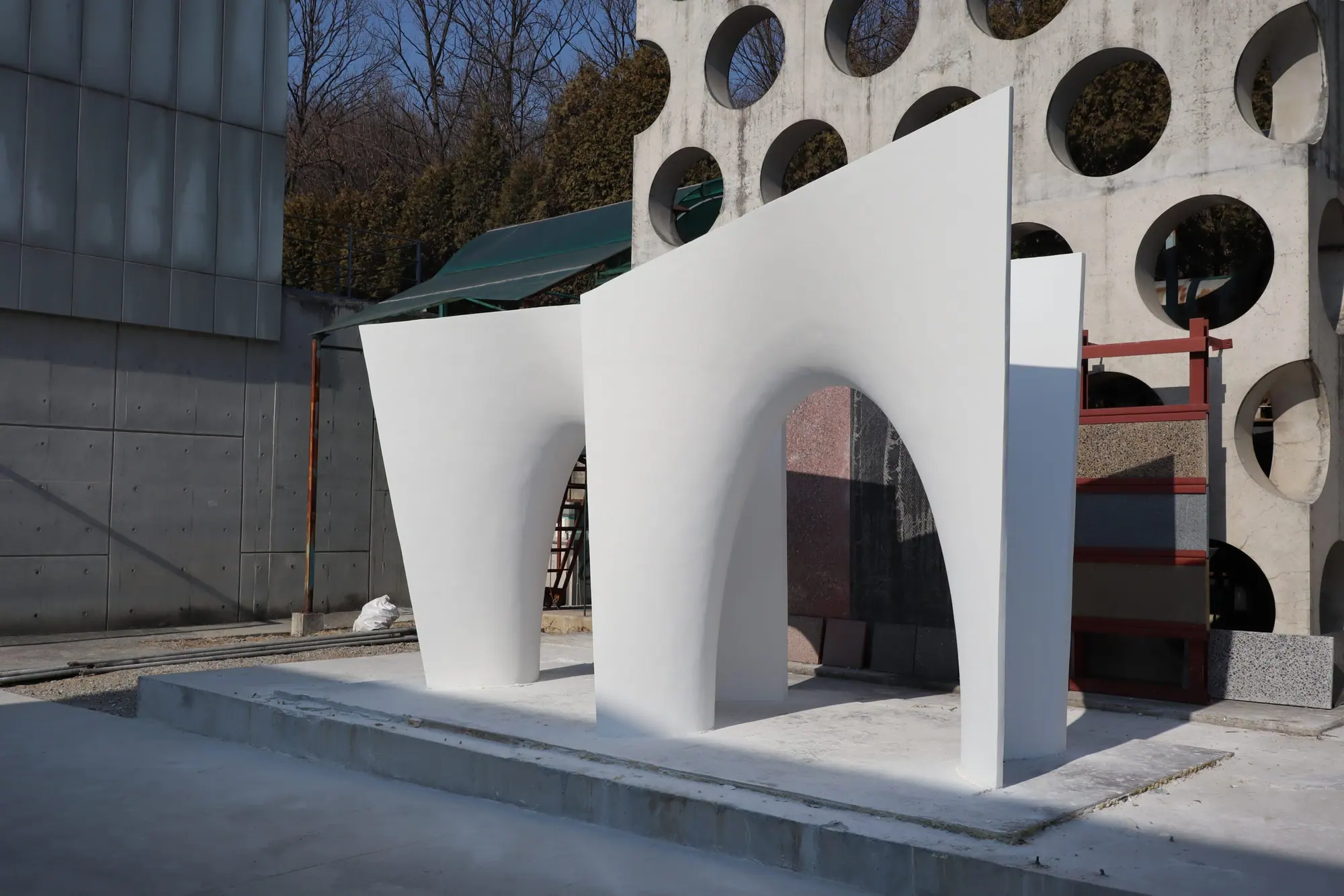
A UHPC structure with a minimal-surface geometry, built by BAT, Hyundai Engineering and Sampyo Cement R&D Center using robot-milled EPS formwork and a rebar mesh 3D printed in metal with WAAM.
- Year
- 2020
- Project Type
- Research / Installation
- Technology
- Robotic Milling, Robotic WAAM
- Industry
- Architecture / Construction
- Joint Research
- Hyundai Engineering, Sampyo Cement R&D Center
Overview
CRUX is a UHPC structure with a minimal-surface geometry. On this project, BAT, Hyundai Engineering and Sampyo Cement R&D Center applied robotic fabrication techniques to test a new construction method for free-form concrete structures.
EPS Formwork
To cast a free-form concrete structure measuring approximately 2 × 5 × 3 m, we built low-cost formwork from EPS instead of the metal typically used for free-form formwork. The complete formwork system was planned as 10–12 segments suited to the assembly process, and these segments were in turn divided into 170 pieces sized to standard EPS blocks (1.8 × 0.9 × 0.6 m). The EPS pieces were machined by robotic milling, and every face was machined — including the curved surfaces and the flat faces where pieces meet — to reduce errors during bonding. After 3D scanning verified the accuracy of the pre-assembled segments, the curved surfaces were given a final paint coating.
Rebar Mesh
Instead of bending rebar to follow the curved surfaces of the structure and tying the bars together, we applied a metal 3D printing technique known as wire-arc additive manufacturing (WAAM). This made it possible to fabricate a precisely shaped rebar mesh and embed it at the center of a relatively thin, 50 mm curved concrete shell.
Gallery
18 images · Click to enlarge
EPS formwork piece layout Rebar mesh piece layout