2025 · Research / Installation
Wave Light
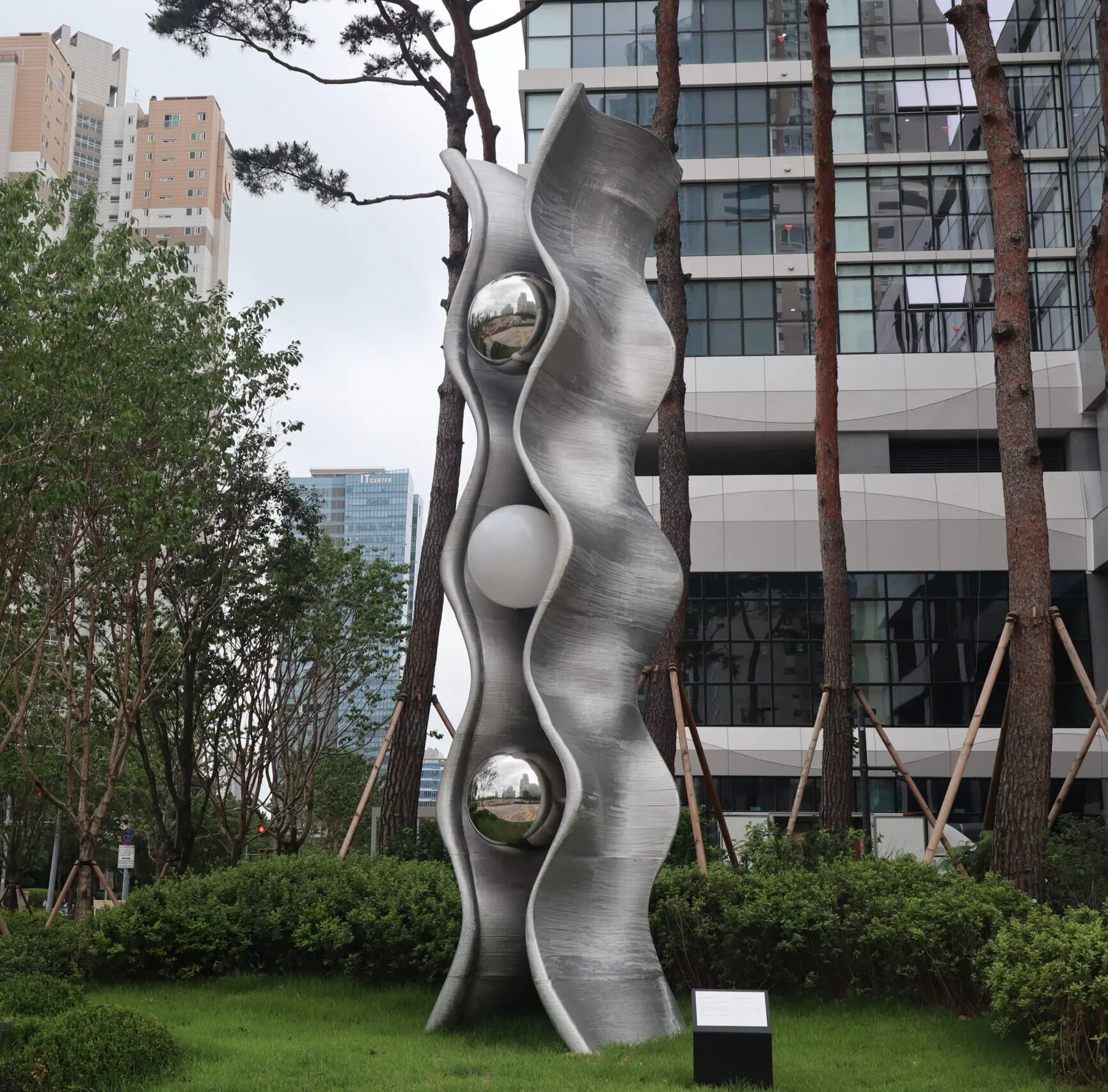
A robotic WAAM research and installation project that combines non-planar slicing, following the curvature of the structure, with process zoning to print overhanging geometry stably without supports.
- Year
- 2025
- Project Type
- Research / Installation
- Technology
- Robotic WAAM
- Industry
- Construction
- Installation
- studio sungshin
Overview
Wave Light was designed around a non-planar deposition strategy that follows the curvature of the structure, so material is deposited along naturally curved toolpaths rather than flat horizontal layers. For process control, each toolpath was divided into multiple zones, and travel speed and wire feed speed were adjusted to the characteristics of each zone.
Non-Planar Slicing
Initially, reinforcement layers were added intermittently to fill the voids in overhanging areas, but because these layers were not connected to one another, they compromised structural stability and deposition quality. To maintain print quality across complex overhangs, the robot torch was tilted at a set angle according to the geometry of the structure, ensuring a stable wire feed. With planar slicing, the spacing between layers became irregular and excessive, making stable deposition difficult; the non-planar strategy kept this spacing small and consistent, with an average deviation within 0.25 mm.
Process Zoning
Reducing torch speed in specific zones during deposition melts and deposits more wire, which made it possible to compensate effectively for small height differences. Within each layer, toolpath segments were also grouped by height deviation, and process parameters suited to each group were applied to achieve uniform deposition quality. The project was designed to print the structure stably without supports, which required precise coordination of thermal control and toolpath design.
Gallery
13 images · Click to enlarge